

Rani Durgavati placed her sword and shield on the takht and raised her palm to send away the sipahis for privacy with her father, King Keerat Rai Shalavahan, at Kalinjar Fort in, Uttar Pradesh.
“He may be a Gond, a tribal by birth. But Dalpat Shah is a Kshatriya by deeds. His valour and political moves speak of his remarkable statesmanship. He is the only King who has been able to keep the Mughals under control, checking their spread towards South India. He fiercely guards his territory, showing those invaders their place. I have also seen his knightly demeanour in many competitions, he impresses me; he is worthy of a Rajput princess’s consort. I see no better marriage match for myself, Baba Hukum!
Durgavati tried to convince her father as well as tacitly announce her decision to marry the ruler of Gondwana land, Dalpat Shah. King Keerat Rai, standing before the life-size portrait of his late wife, intently listened to his daughter. Simultaneously, he recalled his wife’s last words before her death,
“She shall have her will to marry as per her choice. Raise her to be an independent Rajput princess. Promise me! You will allow her to choose her life partner.”
Durgavati was only five years old when her mother died. Her father had raised her as a competent warrior and a free-willed girl, well-versed with armoury knowledge, horse riding, archery and sword skills. Since her early years, she displayed an inclination towards learning political and military aspects of the empire. She often pestered her teachers to narrate and explain the political set up in the epic Mahabharata and Lanka Kand of Ramayana. She would act stubbornly to accompany her father on hunting expeditions. He was always left surprised by her outstanding hunting strategy and markswoman skills. She loved to hear him and being patted,
“You are a true Rajput. You know how to kill an enemy and how to save yourself.”
A Political alliance between the Gond Dynasty and the Rajputs.
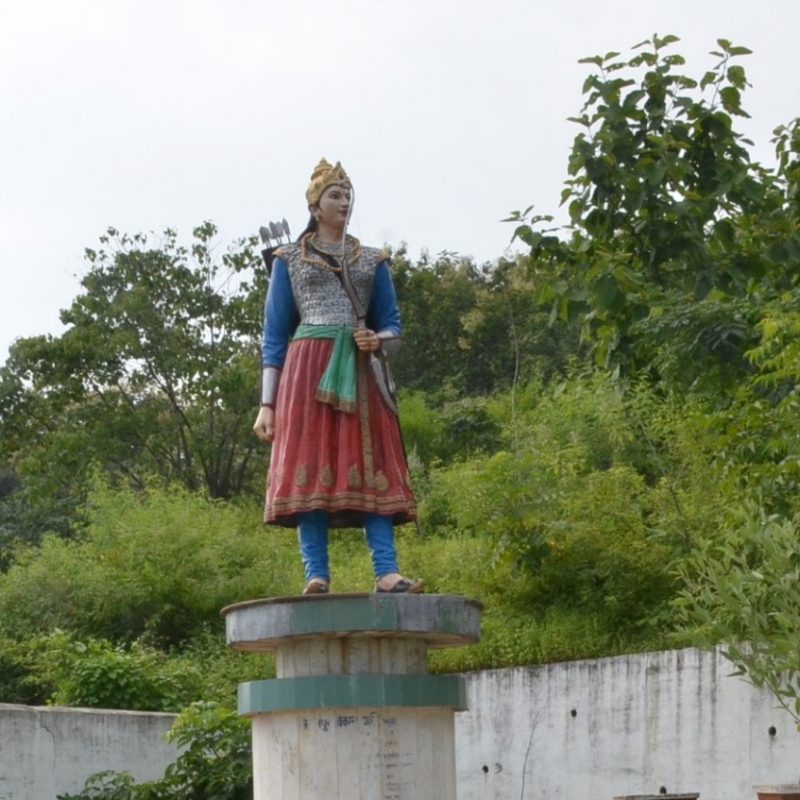
And now, despite raising her as an independent, free-spirited young woman, when she was proposing to marry somebody of her choice, a king from the Gond tribe, he wasn’t in her favour. Just because he belonged to an inferior tribe. But soon reminded of his promise to the dying wife, he gave in to his daughter’s decision and nodded for the marriage. Marriage between a Rajput princess and a Gond ruler also announced a political alliance between the Rajputana and Gondwana dynasties. It was a remarkable move in the history of both the dynasties. Durgavati sat on the queen’s throne beside Dalpat Shah. The latter’s initial hesitation in accepting a Rajput queen soon disappeared by her warmth towards the locals. Dalpat Shah was mesmerized by the beauty of the Rani and amazed by her intelligent views and opinions on socio-political affairs of the kingdom. They both romanticized their goals of resisting the Mughals who were rapidly spreading their empire across India. She absorbed everything from her husband on how to efficiently run an empire. Blissfully their marriage bloomed, and soon they were blessed with a son. Grand celebrations were held across the Gondwana lands at the birth of the heir. They named him Veer Narayan. Durgavati now became thoroughly engaged in raising a worthy heir. Noticing her engrossed in her new phase of motherhood, Dalpat Shah would often mock her,
“It seems my beautiful Rani has lost herself to this innocent cherub. My heart and the courtroom miss you. Spare your time for us also sometimes. I am beginning to get envious of him now.”
And they both would burst into laughter as their eyes filled with dreams of their son’s future as the next ruler of a prosperous Gondwana empire.
In the wee hours of one morning, Dalpat Shah was all dressed to leave for a hunting expedition. Durgavati came forward to hand him his sword. As she rested the sword in his hands, it lost balance and fell down with a thud. The hard metal noise echoed loudly in the hall. Dalpat Shah immediately lifted it and graced it with a forehead touch. With a loving touch on Durgavati’s head and Veer Narayan’s cheek, he left. The bad omen of the sword’s dropping played at the back of her mind all day. It was late midnight, Durgavati restlessly paced in the chamber, for the Maharaja was never so late in his return. As she looked through the Jharokha below, she saw that the mashaals that were dimmed were now burning bright, and many soldiers were running around frantically. Just then a maid and minister barged in
“Maharani, Maharaja has been injured badly. He lost his balance from the horse and fell into a hole in the forest. He is in the Aarogyashala.”
Why Rani Durgavati had to take up the regency of the Gond Dynasty?
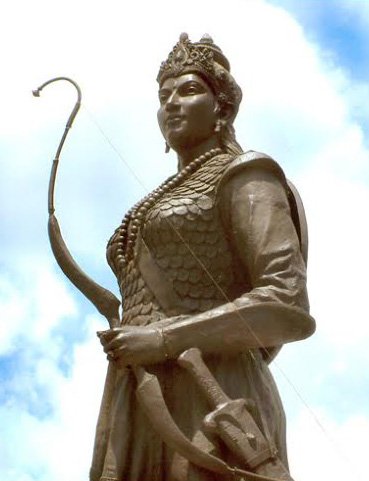
Although a Kshatriya Queen, Durgavati had never experienced this much fear in her life. Intuitively she had already known what was coming. She rushed into the shala and to her horror, she saw that Dalpat Shah had collapsed to the severe head injuries. She stayed in a state of shock for months. All that she repeated to herself was,
“Why do all my loved ones leave me so early?”
As she looked at her toddler son, Veer Narayana, her heart wept even more. She turned into a living corpse.
One day while she sat alone, looking distantly at the far lands, their royal ministers, Adhar Kayastha and Man Thakur walked in, “Maharani! There is an urgency that demands your attention. We are surrounded by Mughals from three sides, our empty throne has become an available invitation for them. Our spies have brought in the news that Baz Bahadur of Malwa is soon planning an attack on us. The empty throne is inviting invaders, Maharani! Until our heir, Veer Narayan reaches a suitable age, you will have to take up the regency. And that too immediately.”
Why Rani Durgavati shifted the capital from Singorgarh Fort to Chauraghar Fort?
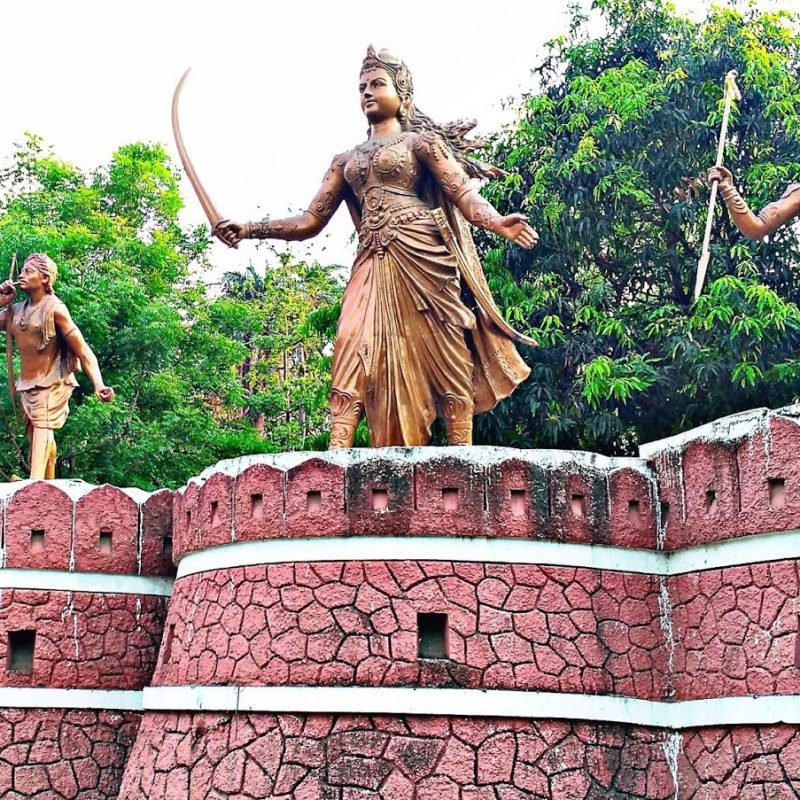
The news of Mughal’s plan to usurp their land sent her blood boiling. For months she was lost in her misery, unable to foresee the consequences the death of her husband had brought in. She left for her chamber without a word. Her anger flowed through her tears as she stood before Dalpat Shah’s portrait. She stood there for a long time as if preparing herself for a big leap. Without wasting any time, she announced herself as the regent. She dressed as a Maharani once again, this time the persona spoke of a military regent, her eyes stone hard and focused. She held Veer Narayana’s hand and regally walked into the hall of ministers for addressing her court. As a first political move, she announced the shift of their capital from Singorgarh to Chauraghar Fort. The announcement sent the hall buzzing with confusion. She explained,
“We shall shift to Chauraghar for its highly strategic location. This shall announce it to our enemies that our land is not weak, vulnerable to an invasion. It’s located over the hill-top amidst the dense Satpura forest, making it hard for any enemy to attack and conquer it. Also, we must immediately prepare our cavalry to meet Baaz Bahdur’s attack. I am sure he is coming soon.”
Her political moves convinced the ministers and the Gondwana people of her astute abilities as a ruler. In unison, they nodded in approval.
“Jai Bhavani!”
Rani Durgavati raised her sword of victory over Baaz Bahadur for the third time. His repeated attacks were answered hands down by the Gond ruler. By now the Mughal ruler had received a clear message that Gond was not an available land for invasion and that the brave Rani Durgavati was an avatar of Goddess Durga herself. Since she took up the post as a regent in 1550, Durgavati had not just resisted his attacks but had caused his army much loss.
Rani Durgavati stood watching her people celebrate their victory with dancing, music and lavish feast. She pampered her warriors well with ample rewards. In the span of 6 years as a ruler she had earned much respect not just from the Gonds but from other dynasties as well. She truly personified the statement that a female ruler is just as capable as a male one. As part of the celebration, the tribe came together and sang her praises. The women heaped accolades on their queen for building several reservoirs for sufficient water supply, thus saving their labour and offering respite from drier days. A group of farmers came forward and shared the story of her immense courage in hunting and getting rid of a man-eating lion. Unlike most rulers, she didn’t just rule from the throne but also treaded in the streets. She was an approachable administrator who empathized with the woes and needs of the common Gondwana people. The praja revered their ruler as a Goddess.
************Mohammad Akbar accompanied by his council of ministers strolled in the Mughal garden, as they exchanged the news from around Hindustan.
“Jahanpanah! Baz Bahadur’s third attempt to invade Gondwana has resulted in his bitter, shameful defeat yet again. The Gondwana dynasty is growing prosperously under a Janana (female) regent, Rani Durgavati,” informed one of the ministers.
“Isn’t she the same Rajput rani under whom the artistic sculptures of Khajuraho and Kalinjar Forts are sculpted?” confirmed Akbar.
“Yes, Jahanpanah!”
“Plan an immediate attack on Baaz Bahadur. I shall address the court on the same tomorrow in Diwan-e-khaas,”
Akbar commanded, beaming with the announcement. Victory over Baaz Bahadur was like eating a piece of cake for the Shehansha of Hindustan. The trumpet of Akbar’s rule over Malwa was heard far and wide.
“How do you have the audacity to suggest an alliance with that Muslim, Asaf Khan? Fearing Akbar, you are seeking security under the shelter of another Muslim. Have you lost your mind completely, Addhar Kayastha?” Rani Durga retorted in disbelief.
Durgavati knew Akbar’s intent behind usurping Malwa. His eyes lay on their prosperous Gondwana land, which shared its territory with Malwa. He also held grudges against them since the Mughals were always kept under the thumb by the Gond ancestors. His proximity was certainly a major threat to them now.
“Call for a meeting with our most trusted ministers. I am certain Akbar will come for us soon. We shall have our defence ready. Make sure no information leaks out. Also, make an announcement to the people in the whole region that their land needs them. Gather all men and prepare them to join the army and fight. We shall arrange our camp in the Narrai Valley. If Akbar is superior with artillery and infantry, we shall counter him with our navigation skills in the dense forest. Our Gond people understand the region well. And that shall be our strength. Let’s go and access our cavalry!”
Durgavati immediately got to action. Veer Narayan, her now adolescent son followed her. He bore a stark resemblance to his late father, Dalpat Shah. His valour and learning skills spoke of a rich gene pool of Rajputs and Gonds. In spite of Durgavati’s resistance, he had declared his will to fight in the battle against Akbar. Headed by their army chief, the Gond soldiers built a camp at Narai Nala. The location was highly strategic as it was situated between hilly range on one side and Gaur and Narmada River on the other, offering just a small opening to the valley. Durgavati’s plan was executed immediately. The locals guarded the valley with hideouts in the forest area of the hills and the tribes watched their river water. The opening was protected with a good number of soldiers equipped with artillery. As predicted, Akbar’s army attacked uninformed. They underestimated the Gonds; their attack was countered from three sides. The chief succeeded in defeating their attack, making them retreat. Though the army chief lost his life battling them, the win boosted the confidence of the Gondwana army.
In the tent, Durgavati was planning the strategy with Veer Narayan, Man Thakur and Adhar Kayastha.
“It’s a huge loss to have lost our most able army chief. With no further argument, it is decided that I shall lead the army now. I shall make Akbar’s army taste my attack. Let’s attack them today itself at night. The darkness and their unpreparedness will benefit us,” Durgavati announced, oozing confidence.
Sensing that their Maharani looked over-confident and less reasonable, they retaliated,
“We could offer a successful defence because we were prepared and guarded on the sides. But walking into their camp at night would simply be a reckless move. Given their kind of artillery and a huge army, it’s like walking into the arms of death. We suggest we play defence and not attack.”
Veer Narayana also nodded to their minister’s reasoning. Having lost her chief, Durgavati didn’t want to lose the confidence of her ministers, so she complied with their advice. Next day, Akbar’s army attacked again. This time with ten times the number of soldiers and with artillery the Gonds had never even seen before. The sight of Akbar’s massive army shook the hearts of Durgavati’s army. Seated on her elephant, Sarman, with Veer Narayana on her side, she thundered,
“Let those Mughal beasts know that the Gondwana land is treaded by brave hearts. Show them the power of our might. Strike to kill! Jai Bhavani!”
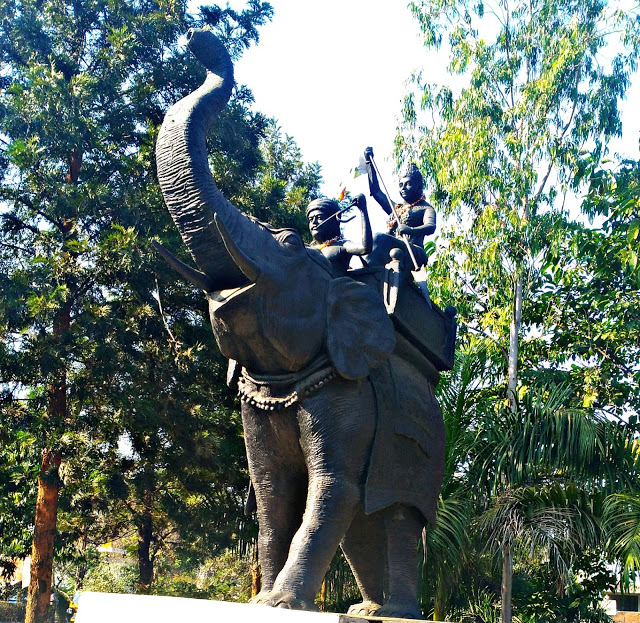
They marched forward. Within a few hours, as Durgavati massacred many soldiers, her son Veer Narayana followed her with equal might, slaying whoever fell in his path. The Mughal army chief knew where he had to strike to weaken Durgavati. He surrounded young Veer Narayana with his soldiers. Veer Narayana lost his life fighting them. The sight of his dead body paralyzed Durgavati. The heart of a warrior transformed and weakened in motherly sentiments. Her grip on the sword loosened as her eyes moistened with tears.
“Fight Maharani! Look straight! Tighten your grip and strike!” yelled Man Thakur from a distance. He could see her losing her senses. Before she could regain her strength and mind, an arrow pierced her neck and ear. She began bleeding profusely.
“We must retreat Maharani! Shall I take you back to the camp?” proposed her mahout as he saw her losing her consciousness.
“We must retreat Maharani!” Man Thakur and Adhar Kayastha shouted in unison.
With no reaction to their words, Durgavati looked at her son’s body. Her hand reached to the dagger hanging on the left side of her waist. With one sharp move, she stabbed herself with a loud shout,
“Rajput blood never accepts defeat!”
With those last words, she died. She chose to honour her own death than live under the Mughal rule. Although Akbar took over the land, the region followed her way of administration and the people of Gondwana worshipped her as an avatar of Goddess Durga. History glorifies her name in gold – as a brave legendary queen of the Gondwana land.