
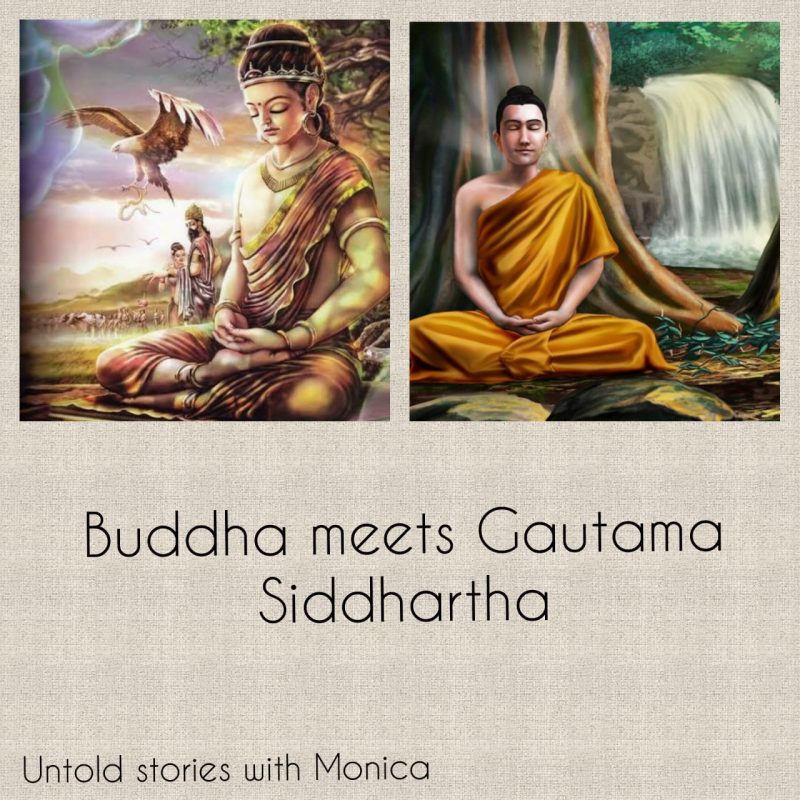
The gurgling sound of the river called for Buddha’s attention as he strolled in the forest. He looked into the crystal clear water of the river. To his surprise, the water bore a reflection of Gautama Siddhartha and not Buddha. Adorned in fineries, bearing a delightful smile, the innocent eyes with a fidgeting body language. He ran his hand, to clear the illusion, but the reflection stayed. Buddha was seeing his earlier self, before his moment of awakening and titled as Buddha. He smiled at the reflection as Siddhartha struck a conversation.
“We are one person, but two personalities now. Don’t you find it strange, Buddha?” nudged Siddhartha.
Thinking deep, Buddha nodded with a yes. He noticed the vibrancies of his youth, curiosity and the twinkle of ignorance in his eyes. Looking at Siddhartha attentively, Buddha inquired, “Do you recall, how did this transience of Siddhartha to Buddha occur and how you felt during that time?” Siddhartha reflected, “My accidental encounter with the four sights; an old man, a sick woman, a corpse and a monk brought a harsh reality check on life. I was brought up in a palace, where the natural course of human existence wasn’t at my disposal. I was only exposed to the pleasures, youth, good health and beauty. It became my definition of human life. Old age, death, diseases were never seen or experienced by me. Those sights put me face to face with the other unknown realities. And it generated fear in me. For anything that is new and unfamiliar feels like a threat to the existing one. My ignorance on life was revealed. Those sights consumed me. They played before my eyes, day and night. I tried to overcome them by hiding beneath my luxurious life. But I was stirred deeply by those encounters. And that night, when my curiosity was at peak I found the courage to take the leap. To set out on the unknown path, to see, learn and experience the new truths. Hence I left the palace, to explore the other side of Life.”
Buddha probed further,
“It must have been difficult. From a protective, pleasurable life at palace to a life without any of it. How did you manage to continue practicing the rigorous penance? What was your driving force?”
Displaying his youthful exuberance Siddhartha answered,
“Yes, it was difficult. Very difficult. The initial phase of unlearning specially. From a habitual life of luxury, to a life of self-dependency was challenging. But I was always the spirited one. My quest to indulge and consume these new experiences was equally strong. I absorbed every truth of human existence. I experienced them with first hand encounter. I put myself through them. After doing it for years, after seeing the strength and vulnerabilities of living beings, my moment of awakening happened. I felt liberated. And thus you, Buddha was born. Right?”
Buddha nodded with a “Yes!” This time Siddhartha asked Buddha curiously,
“What was most important learning in entire course of the journey that you undertook?”
Buddha replied, “The most important lesson was that of the stages of learning. The stages that lead to liberation and enlightenment. The stages of acknowledgment, learning, analysis and acceptance. Acknowledging one’s own emotions and needs, whether good or bad. Followed by learning, through search and practice. Then comes analysis, gathering the answers of how, why, what and who? And lastly having seen and been through everything comes the stage of acceptance. Acceptance of one’s self and of the universe one is connected to. And most importantly, to be truly awakened to life, one must go through these stages.”
Siddhartha was intrigued, he asked further, “And what did you learn in the end? What’s the best way to lead a good, peaceful life?”
Buddha replied with radiance of wisdom.
“It’s the path of balance. To find that path, one must explore and understand both, birth and death, light and dark, pain and pleasure, hurt and healing. For all come together as one to sum up as life. To attain moksha, symbolic of being unaffected by the external world, to reach an absolute calm within. One must accepts the faces and phases of good or bad with a similar spirit. In doing so, one is able to break the cycle of sorrow and joy, of hurt and healing, of making and breaking, of attaining moksha, the absolute state of being, in sync with the universe.”
After having an enriching conversation, Siddhartha and Buddha exchanged a similar glance of fulfilment as the reflection in the river submerged into the ripples.